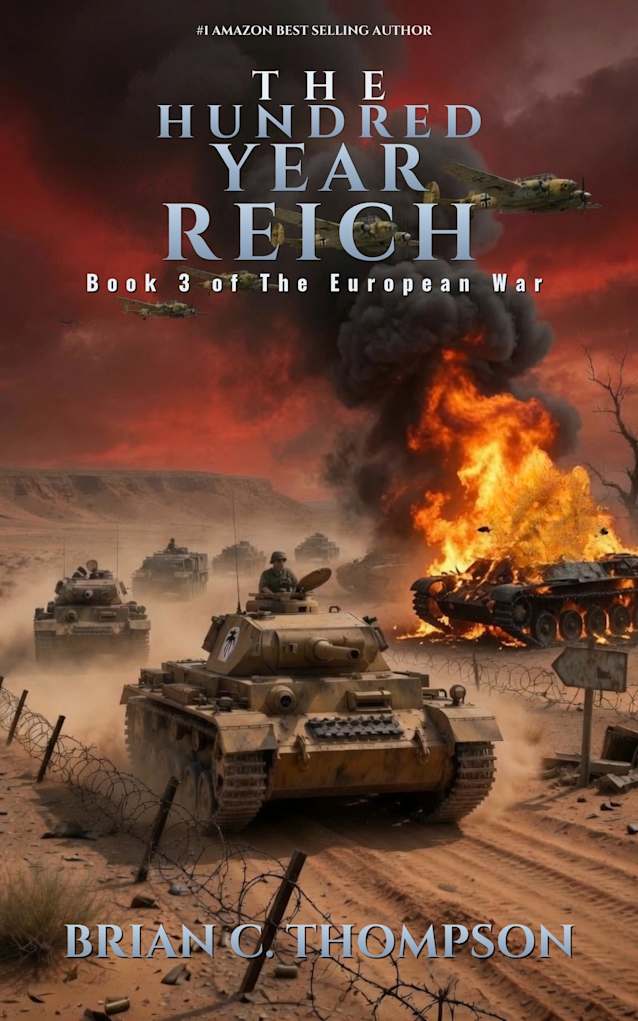
The Hundred Year Reich: Book 3 of the European War
About
The Reich has won the continent. Now it has to hold it.
By the winter of 1940, Hitler commands more of Europe than Napoleon ever did. France is beaten. Moscow has fallen. Poland endures on borrowed time, and Britain stands alone behind a wall of grey Atlantic water, its lifeline being strangled one convoy at a time. In Berlin, they have started to say the word permanent. They have started to say a hundred years.
But a conquered continent is not a finished one.
In the North African desert, a British offensive turns a paper Italian empire into a rout in a matter of days, and Berlin sends a general named Rommel to make sure it never happens again. In the Atlantic, the U-boats tighten their grip on the island that will not surrender. In the frozen East, a German tank officer named Georg Marchner writes a one-sentence report about a new Soviet machine that should not exist, and no one above him wants to read it. At Bletchley Park, a mathematician reads the enemy’s mail and cannot tell the man she loves what it costs her. And in a snow-covered hall in Gorki, they bury a dictator while the empire everyone counted dead begins, quietly, to breathe again.
Then, on a clear December morning, the war stops being Europe’s alone. Pearl Harbor drags a sleeping giant out of its ocean and points it the wrong way, toward the Pacific, and the men fighting for Europe are left to wonder how long they can hold until America turns around.
Five empires now collide on one exhausted continent: the German at its arrogant height, the British at the end of its endurance, the Soviet risen from its own grave, the Japanese ascendant, and the American reluctant and vast. Every road runs to the same place, a nameless railway halt on the Egyptian coast, sixty miles from Alexandria, on the only ground in Africa that cannot be flanked.
It is called El Alamein. And on the twenty-third of July, 1942, the two greatest wars ever fought arrive there at the same hour.
THE HUNDRED YEAR REICH is Book Three of The European War, the alternate-history saga that runs parallel to The American War and converges with it at El Alamein. Meticulously researched and built on the real machinery, distances, and men of 1940–1942, it is written for readers of Robert Conroy, Harry Turtledove, and Jeff Shaara, and for anyone who has ever asked how close the twentieth century came to going the other way.
Every great story begins with family.